Most Meta ads for jewellery brands start the same way: one sales campaign, every product thrown in, and a hope that the algorithm sorts it out. It usually doesn’t. The bestsellers carry the losers, and you can’t see which is which.
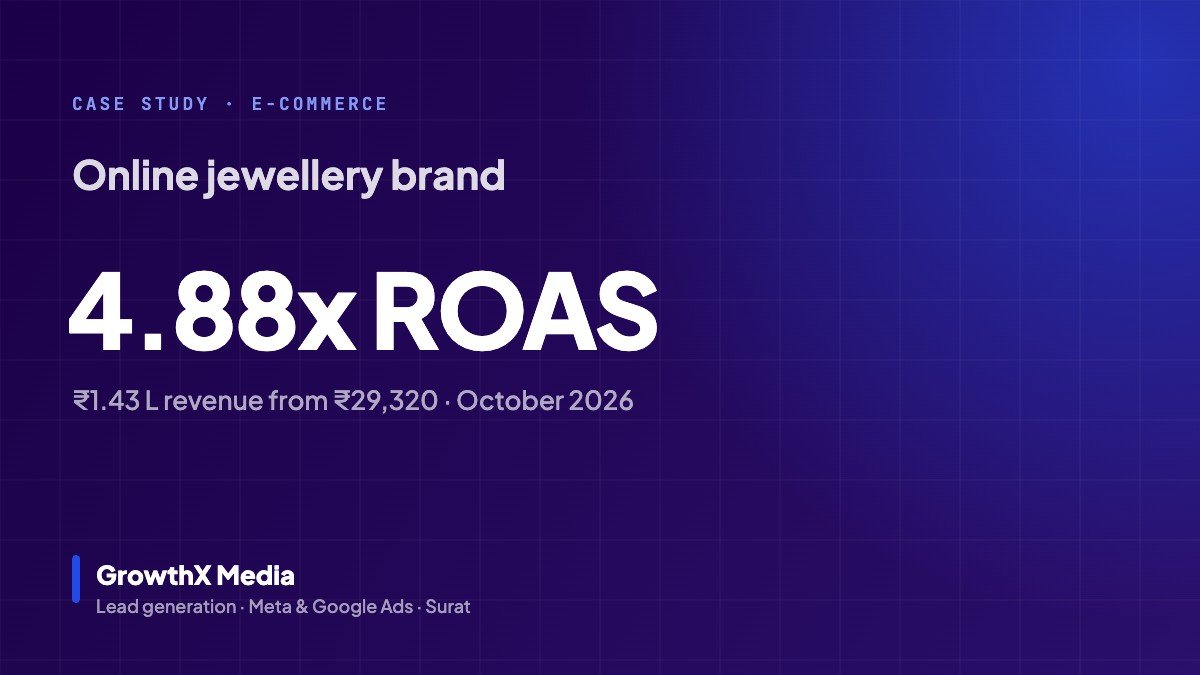
For an online jewellery brand we work with, we did the opposite. Here is what October 2026 looked like.
| What | October 2026 |
|---|---|
| Ad spend | ₹29,320 |
| Website purchases | 217 |
| Revenue from those purchases | ₹1,43,128 |
| ROAS | 4.88x |
| Cost per purchase | ₹135 |
| Adds to cart | 1,410 |
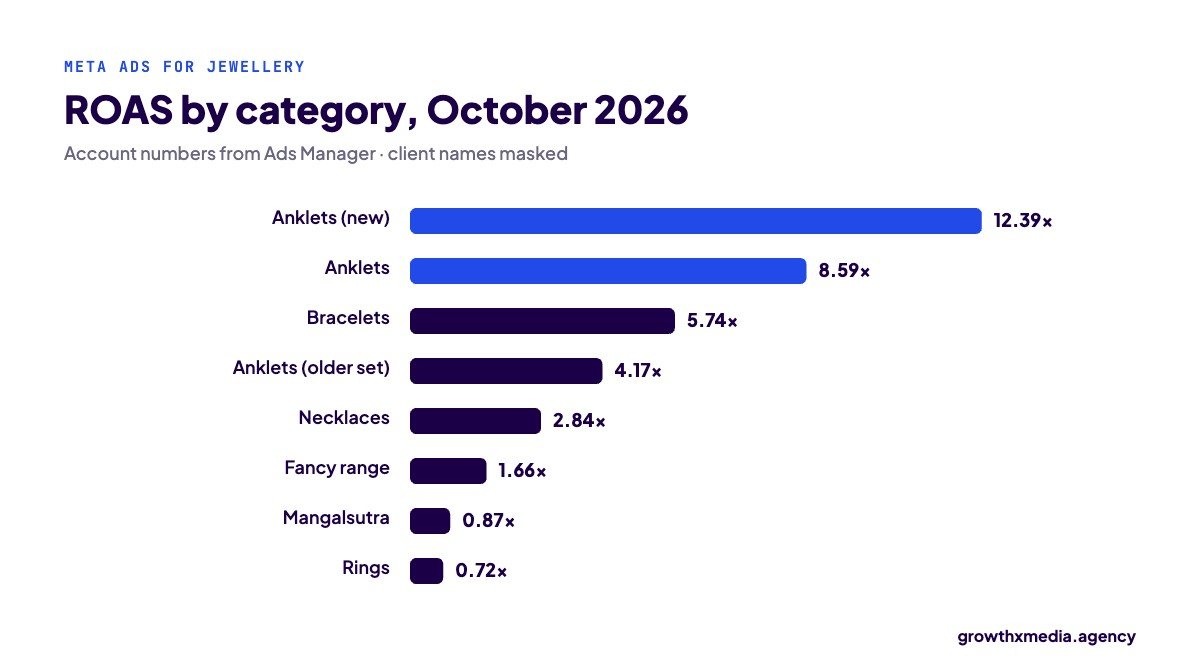
All numbers are account totals from Ads Manager. The client’s name stays private.
Meta ads for jewellery work better one category at a time
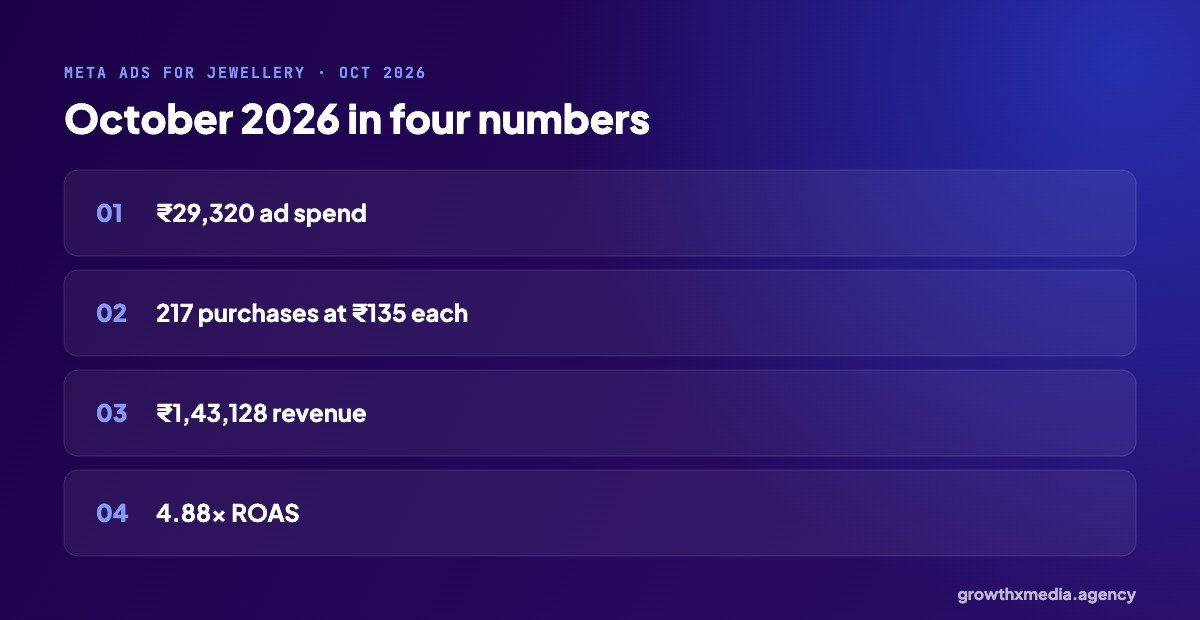
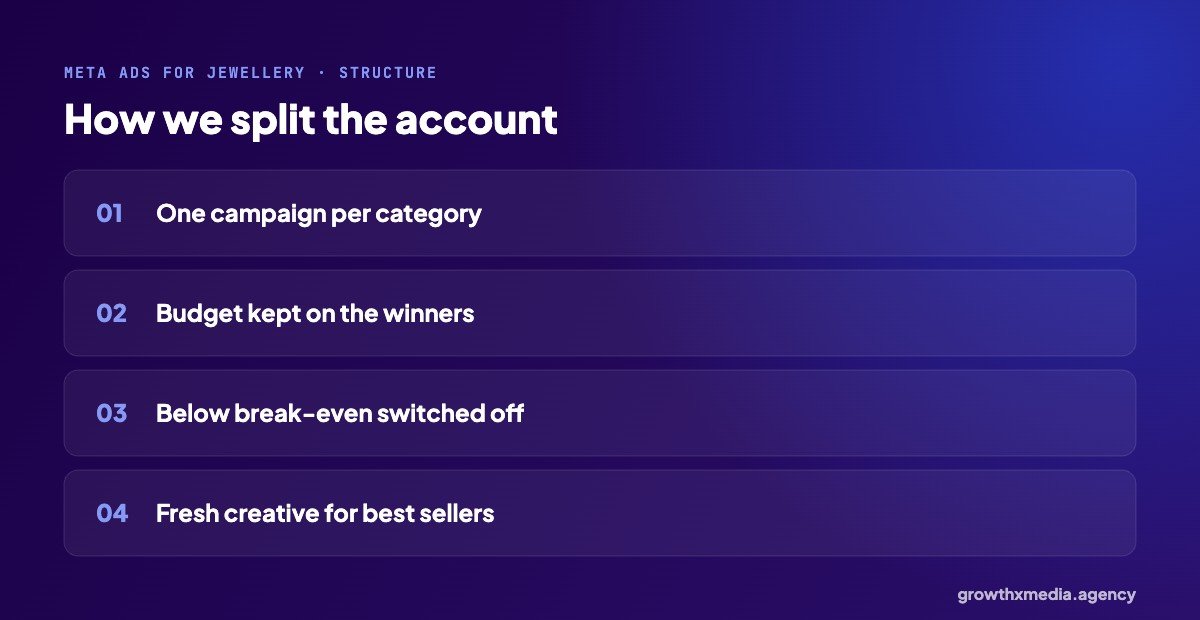
Every category got its own sales campaign: anklets, bracelets, necklaces, mangalsutras, rings and a fancy range. Each one had its own daily budget, between ₹300 and ₹510.
That sounds like more work, and it is. But it answers the only question that matters in e-commerce: which products actually pay back?
| Campaign | Purchases | ROAS | Status |
|---|---|---|---|
| Anklets (launched 30 Oct) | 14 | 12.39x | On |
| Anklets (launched 7 Oct) | 101 | 8.59x | On |
| Bracelets | 41 | 5.74x | On |
| Necklaces | 27 | 2.84x | On |
| Anklets (older set) | 24 | 4.17x | Off |
| Fancy range | 5 | 1.66x | Off |
| Mangalsutra | 4 | 0.87x | Off |
| Rings | 1 | 0.72x | Off |
What the split showed us
Anklets were the clear winner. One anklet campaign alone brought 101 purchases worth ₹66,459, at ₹76.64 each. Rings and mangalsutras spent money and returned less than they cost, so they were switched off instead of being tweaked for another month.
If all eight had been in one campaign, the anklet results would have hidden the ring losses. The account would have looked fine on average and quietly wasted money every day.
ROAS is the number, not clicks
For a store, the only scorecard is revenue against spend. We read ROAS per campaign in Meta Ads Manager every week and move the budget accordingly. Adds to cart are a useful early signal, 1,410 of them at about ₹21 each here, but they don’t pay the bills.
If you sell online, try this
- Split your catalogue into categories that customers actually shop by.
- Give each category its own campaign and a small budget to start.
- Judge each one on ROAS after a fair test, not on clicks or reach.
- Switch off the ones that stay below break-even. Put that money on the winners.
See how we run campaigns for stores and D2C brands on our e-commerce and retail page, or read how much to spend in your first month.
Common mistakes with Meta ads for jewellery
Most of the jewellery accounts we audit make the same few mistakes. None of them are about targeting.
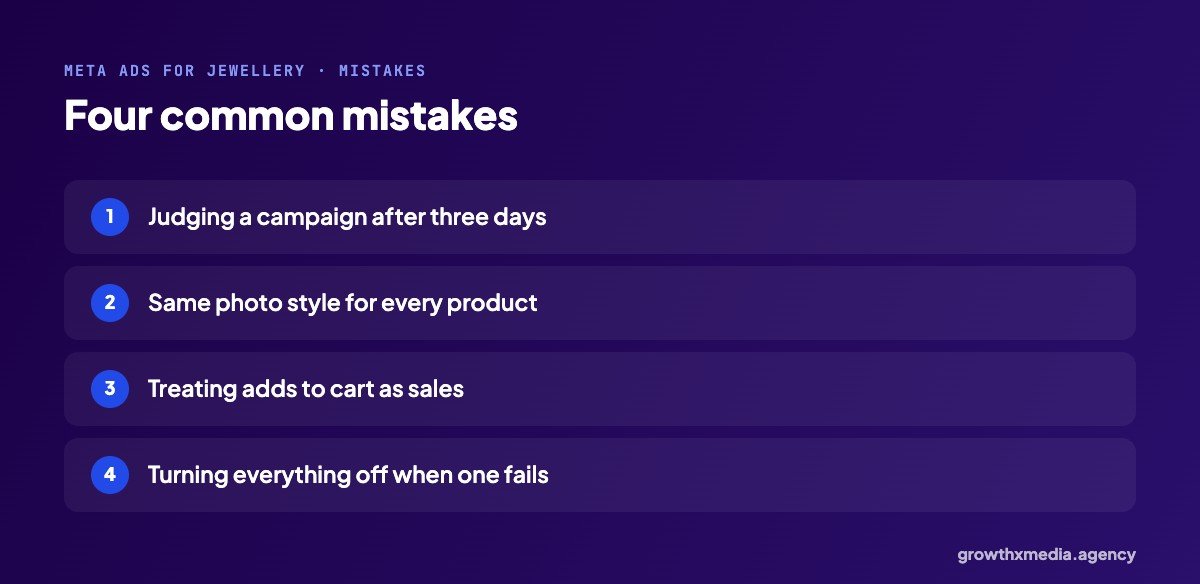
- Judging a campaign after three days. Jewellery is an emotional, considered purchase. Give each category a fair run before you decide.
- Using the same photo style for everything. An anklet and a mangalsutra are bought for very different reasons, and the creative should show that.
- Treating adds to cart as sales. Adds to cart are a hint, not a sale. In this account the rings had adds to cart and still returned less than they cost.
- Turning everything off when one category fails. Here, rings lost money while anklets made more than eight times their spend. Same brand, same month.
The fix for all four is the same habit: look at each category on its own, every week, and let the numbers decide where the next rupee goes. It’s not clever. It works because it removes guesswork from a business where margins differ a lot from product to product.
One more thing worth saying. 4.88x ROAS is the account average for October 2026, not a promise. A new store, a different price range or a weaker website would give a different number. What carries over is the method.
Meta ads for jewellery: quick answers
What ROAS did the jewellery brand get?
4.88x in October 2026: ₹1,43,128 in sales from ₹29,320 of ad spend, across 217 purchases.
Why split campaigns by category?
Because categories perform very differently, from 0.72x for rings to 12.39x for a new anklet set. In one campaign, the winners hide the losers.
What should I do with categories below break-even?
Pause or rework them, and move the budget to the categories that pay.
Related reading: What Is a Good ROAS? Real Numbers From an Indian D2C Brand, Video Ads for Lead Generation: What Worked in 3 Real Accounts and Facebook Ad Fatigue: 5 Warning Signs and How We Fix It.
Selling online and not sure which products pay back? Get a free ad account audit and we’ll show you, category by category.